Estepona is two places in one municipality. One is a compact Spanish town with an old centre, a seafront and a working port. The other is a long line of residential developments and golf courses along the coast on either side of it. Which of the two you have in mind explains most of what follows.
The town is lived in all year. On 1 January 2025 the municipality had 79,621 registered residents, up from 66,566 in 2014 (INE (opens in a new tab)). The regional statistics institute gives an average age of 42.4, with one in five residents under 20. In the 2023–24 school year, 19 schools offered primary education and 10 offered compulsory secondary education, and the public health service counts two health centres in the municipality (IECA, municipal profile (opens in a new tab), 2025). The tourism office lists a Wednesday street market and a Sunday market at the marina (Turismo Estepona (opens in a new tab)).
It is also an international place. The same IECA profile records 22,778 foreign nationals in 2025, 28.6% of its population count, with British citizens the largest group, at 17.9% of them. Public life still runs in Spanish: the town hall, the health service and the state schools work in Spanish, and a new resident should plan for that.
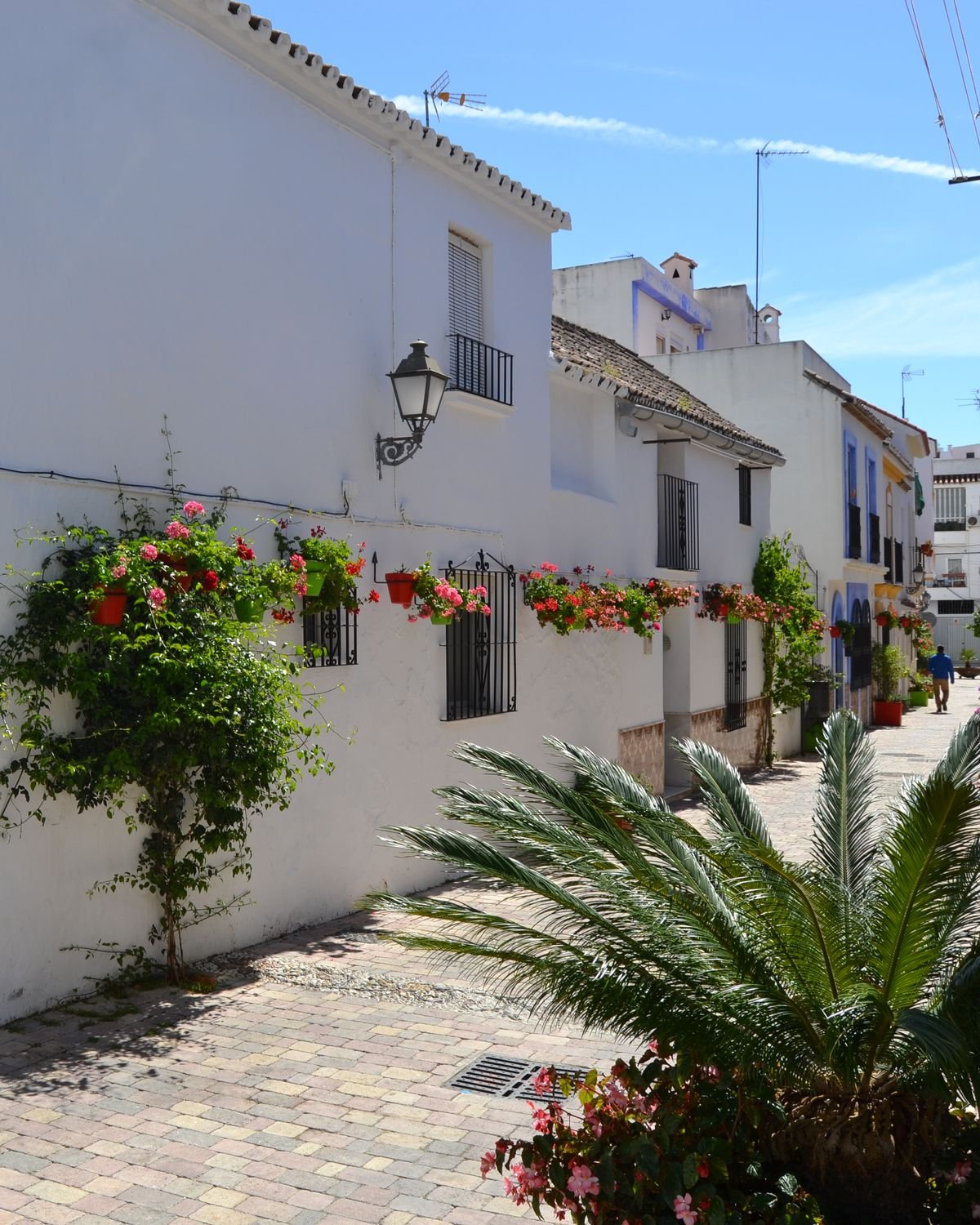
The old town has been remodelled street by street, and the town hall promotes Estepona as the “Jardín de la Costa del Sol”, the garden of the Costa del Sol, for its flower-lined streets. It has also turned blank walls into a mural route: in March 2026 the town hall counted more than 70 large murals (Ayuntamiento de Estepona (opens in a new tab)), alongside a poetry route and a sculpture route.
The port combines a marina and a fishing port, both within the Andalusian ports system. The marina has 447 berths run by its operator and 36 run by the Real Club Náutico (Puertos de Andalucía (opens in a new tab)). In February 2026 the regional ports agency put the marina out to tender as a 30-year concession, with a minimum investment of €10 million and a remodelling project required from the winning operator (tender conditions (opens in a new tab)). These are conditions of the concession, not works under way.
Along the shore, the municipality has 23 km of coastline, which the town hall is joining up with a continuous coastal path. In April 2026 it had sent the designs for the last three sections, at Isdabe/Atalaya, Guadalmina Baja/Casasola and Costa Natura, to the regional government for authorisation (Ayuntamiento de Estepona (opens in a new tab)).
Much of what is bought here is new. In 2025, 888 of the 3,466 notarised home purchases in the municipality were new homes, about one in four (IECA (opens in a new tab)).
For an international buyer, the appeal is the combination.
Estepona offers a year-round Spanish town with the services of the Costa del Sol within reach: British-curriculum schools in the municipality, a private hospital with 24-hour emergencies, a large foreign community, Marbella next door and Málaga airport, with 26.76 million passengers in 2025, about an hour away by road.
Some practical points are worth knowing. Asking prices average €4,961 per m², about a sixth below Marbella’s €5,956 (idealista, Estepona (opens in a new tab); Marbella (opens in a new tab), August 2026). Estepona has no railway station: the C1 commuter line to Málaga airport and Málaga starts in Fuengirola, and the rest of the journey is by road. The public hospital in town is part of the Hospital Universitario Costa del Sol network, based in Marbella, and is expanding: in November 2025 the Andalusian health service announced 58 new staff posts to open 80% of its planned services (SAS (opens in a new tab)). For specialist care, check whether it is provided in Estepona or in Marbella.
The town has three urban bus lines. In the timetables Avanza linked in September 2026, town line E1 runs roughly every 25 to 40 minutes on weekdays, while line E2 has eight departures a day in each direction and line E3 four (Avanza, Estepona urban buses (opens in a new tab)). If you plan to live without a car, check the walk to the nearest stop and your regular journeys.
Estepona suits people who want the Costa del Sol’s international services in a real Spanish town rather than a purpose-built resort. Buyers who rely on public transport will find the town centre the most practical choice, with shops and services within walking distance.
Population: INE and IECA, 2025. Schools: 2023–24 school year. Asking prices: idealista, August 2026. Bus timetables: as linked by Avanza in September 2026. Prices, rates and timetables change; confirm current figures before deciding.